Facebook
 Telegram
 Instagram
 posternak.oleg@gmail.com
  Facebook
 Telegram
 Instagram
 posternak.oleg@gmail.com
 Moldova prepares to vote
Moldova will elect its parliament in a week, and while elections in Ukraine are still only theoretical, it is important to closely follow the electoral battle unfolding in the neighbouring country.
Currently, the electoral battle in Moldova is mainly between four political forces: President Maia Sandu’s Action and Solidarity Party (PAS), the pro-Russian Patriotic Bloc of Socialists, Communists, Hearts of Moldova and Future of Moldova led by Igor Dodon, the covertly pro-Russian bloc Alternative of Chisinau Mayor Ion Ceban and ex-socialist Alexandr Stoianoglo, and Renato Usatyi’s populist Our Party, which is seen as a possible partner for PAS and Sandu’s potential saviour.

Election strategies
This time, Sandu also focused on the theme of Moldova’s European integration as an existential and fateful choice. The opening of negotiation clusters with the EU and the lavish EU–Moldova summit in Chisinau with visits by European leaders became the “highlight” of the ruling party’s campaign. The fear of losing the European vector is being used as a mobilising factor. PAS’s main message, “The European path – security and development”, is aimed at young people, the diaspora, and urban voters. The party even added the symbols “UE 2028” to its logo, a promise to join the EU in three years.
Sandu’s party is counting on the diaspora vote again, but this time it may not offset the electoral disaster at home. Many disgruntled domestic voters — especially after the diaspora decisively swung the 2024 referendum in Sandu’s favour — are now highly motivated to “show their teeth” to her. The opposition is actively mobilising this mood.
Voters expected systemic change: tangible social effects of the EU course in the form of economic growth, job creation, and steps toward unifying the country. Instead, Sandu’s popularity has entered an objective “recession.” This always happens to leaders who once held full power but failed to use it, losing masses of supporters.
Today, Sandu is forced to use standard playbooks for politicians fighting a growing anti-rating. PAS tries to dominate Moldova’s media space with state programmes, PR campaigns, and diaspora-focused targeting. Yet much of it looks like box-ticking exercises unlikely to inspire voters to give Sandu another chance.
The Patriotic Bloc openly broadcasts pro-Russian rhetoric, relying on Russian-speaking voters, pensioners, rural residents, and the ethnic regions of Gagauzia and Transnistria. Its messages revolve around sovereignty and social justice.
The opposition, meanwhile, exploits digital mobilisation via Facebook, YouTube, Telegram, and local media in Gagauzia and Transnistria. Bot networks have expanded significantly. Alongside this, Shor’s well-built voter-buying machine, estimated at 100–150,000 people (around 8% of the electorate), is being deployed.
The Alternative bloc’s main technological task is to pull urban voters, especially in the capital, away from PAS. Romania’s recent decision to ban Ion Ceban from entering the Schengen zone has tied him more closely to the pro-Russian camp in the eyes of voters.
Renato Usatyi’s Our Party mainly attracts pro-Russian loyalists. In the 2020 presidential election, Usatyi even urged his voters not to support Dodon, indirectly helping Sandu. His party may now serve Sandu’s interests on the pro-Russian flank and potentially become a PAS coalition partner — depending on voters’ will.
Manoeuvring with sociology
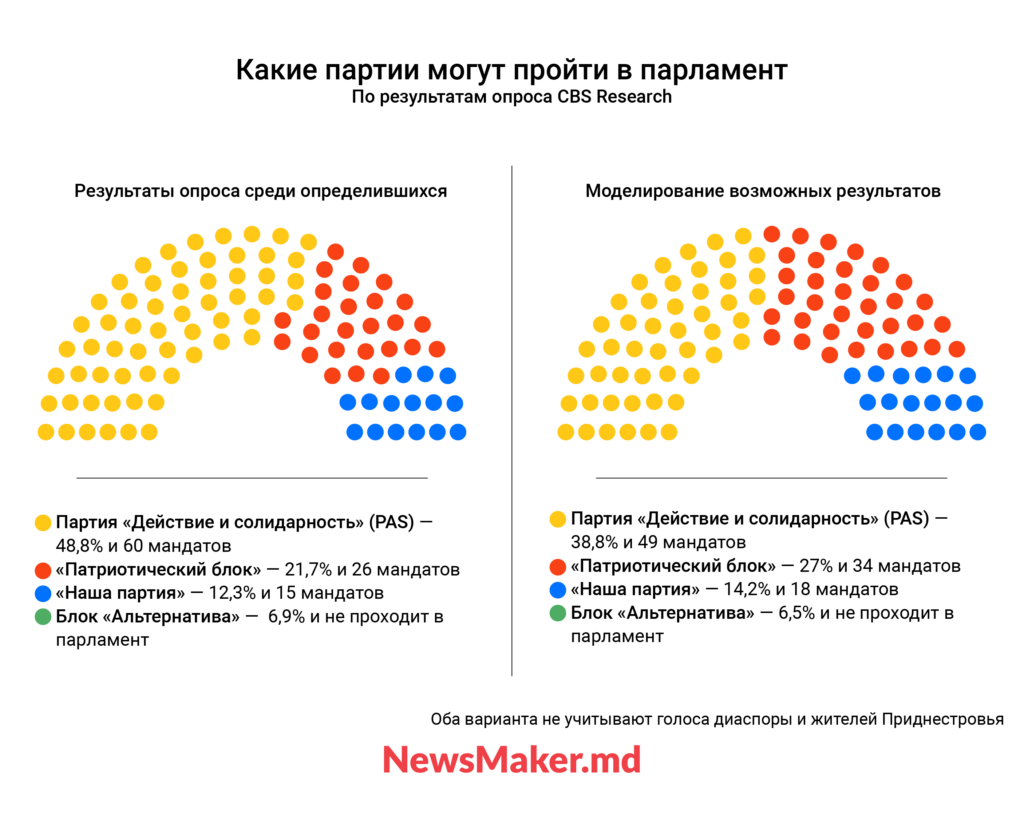
The most consistent political tool in Moldovan campaigns is formative sociology. This week CBS Research published figures among decided voters: PAS – 48.8%, Patriotic Bloc – 21.7%, Our Party – 12.3%, Alternative – 6.9%. With such numbers, “Alternative” would fail to cross the 7% threshold for blocs. At the same time, around 27% of voters remain undecided or hide their preferences.
Publishing polls inevitably shapes public opinion. Between 10–25% of voters follow manipulative ratings. The undecided often align with the “majority.” Anxious voters also prefer the “safe” choice they believe coincides with the majority.
But Moldovan polling has flaws: it excludes the diaspora and Transnistria. Hence the failed forecasts for the 2024 presidential election and referendum. For example, 277,000 Moldovan citizens in Transnistria are on voter rolls, many having Moldovan passports to benefit from EU visa-free travel since 2014.
Sandu failed to develop an effective approach to these voters. It is a mistake to assume all on the left bank are staunchly pro-Russian. Many are sceptical of the “Russian world” and not loyal to Putin. Many work on the right bank and have family ties there. Yet they remain dependent on local elites, whose loyalty to Moscow secures their “façade state.”
After 2022, dismantling this criminal structure could have toppled the Transnistrian illusion of statehood with support from Ukraine, the EU, and Romania. Sandu could have entered history as a unifier. She did not.
Instead, authorities now restrict Transnistrian voters by cutting polling stations from 31 in 2024 to just 12 today, while launching “urgent bridge repairs” across the Dniester. This may be justified as a security measure, but risks tarnishing Sandu’s image with accusations of undemocratic practices.
Russia’s “breakthrough” in the elections
Moldova has become a testing ground for maximised Russian interference. Russia uses Orthodox priests for propaganda, bot networks such as “Matryoshka”, and fake text messages offering rewards for votes.
Russia employs “political proxies”: Shor’s banned Victory bloc, Dodon’s openly pro-Russian Patriotic Bloc, and Ceban’s covertly pro-Russian Alternative. After the 2024 elections, Moscow saw that the purely left-wing electorate was insufficient, so it designed “Alternative” as a pseudo-pragmatic bloc, not opposed to the EU on paper, to siphon pro-European voters lost by PAS.
Fatal mistakes
Sandu’s main failure was doing nothing to neutralise this protest electorate. Many voters now see the elections as retribution for broken promises. Instead of fostering a softer pro-European partner party, Sandu monopolised the European idea. Through a campaign of fear, PAS drives voters to “grit their teeth” and reluctantly vote again. This gamble may prove to be her advisors’ fatal mistake.
Meanwhile, Alternative focuses on socio-economic issues rather than geopolitics, posing as a “third force” — supporting EU integration while calling to restore Russian gas supplies.
Sandu’s past majority cannot be repeated, but her government cannot afford to simply lose power. Too much is at stake — not only Moldova’s future.
This is the paradox: how to retain parliamentary power with weak chemistry with the people. Can Moldova’s democratic, pro-European team risk temporary authoritarian habits in the name of safeguarding the European course and Eastern European security? Can democracy itself be sacrificed for state security in the face of Russia’s hybrid war?