Facebook
 Telegram
 Instagram
 posternak.oleg@gmail.com
  Facebook
 Telegram
 Instagram
 posternak.oleg@gmail.com
 The Policy of Two Chairs: “Pro-Western” Armenia Aids Putin
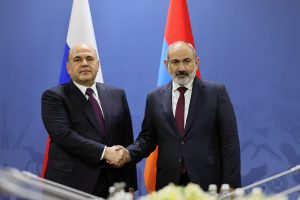
Armenia, which has been actively pursuing a policy of “reorientation” toward the West, did not join the Council of Europe declaration supporting the International Criminal Court’s arrest warrant for Putin. This was stated by Armenian Foreign Ministry spokesperson Ani Badalyan on September 7. Thus, Yerevan, which ostentatiously demonstrates its “distancing” from Russia to the global community, did not support the U.S. and EU initiative to establish a tribunal for “crimes of aggression against Ukraine.”
Official Yerevan, following a “two-chair” policy, on the one hand, makes a concerted effort to create the impression of reorienting toward the West, while on the other, is in no hurry to sever ties with Putin. This is especially evident in Armenia’s role in circumventing anti-Russian sanctions. “Despite the deterioration of political relations between Armenia and Russia, bilateral trade is flourishing, forcing Western partners to rethink Yerevan’s approach to sanctions,” the pan-European publication Euractiv noted on March 28, 2024.
Since the beginning of this year, the EU has adopted its 13th and 14th packages of anti-Russian sanctions. In total, they include 310 individuals and entities from eight countries “actively involved in circumventing EU sanctions.” However, these lists still do not include Putin’s primary logistical hub, which has been helping him evade sanctions for over two years. The “pro-Western” Armenia is allowed to violate the sanctions regime, despite the European Commission’s loud slogan about “relentlessly pursuing those who help Russia circumvent sanctions.” As early as May 2023, Jim O’Brien, Director of the U.S. State Department’s Office of Sanctions Coordination, explicitly stated that Washington considers Armenia one of the countries helping Russia bypass sanctions. But words remained words: the U.S. has yet to take any action to prevent the supply of sanctioned goods to the aggressor state via Yerevan. There is ample evidence that Armenia serves as Russia’s primary channel for circumventing sanctions.
The “Diamond” Scheme
According to the UN Comtrade Database (the UN’s international trade statistics database), in 2023, Armenia imported 3.5 million carats of processed and unprocessed diamonds worth approximately $561 million. Of these, 48% came from Russia. That same year, Armenia exported a record 4.5 million carats of diamonds. On July 24, 2024, the Organized Crime and Corruption Reporting Project (OCCRP) concluded: “Foreign trade data indicate that exports mainly consist of unprocessed stones rather than diamonds cut by Armenian craftsmen. In other words, Armenia has become a re-exporter, a transit country.” It is emphasized that the re-export of Russian diamonds continued into the first half of 2024: “The primary export market was the UAE, while the main source of imports remained Russia.”
Even Armenian economists acknowledge the fact of re-export. “If Armenia exported 4.5 million carats of diamonds in 2023—30 times more than the country itself produces—this is a glaring indication of a growing re-export trend,” economist Agasi Tavadyan summarized in an interview with Deutsche Welle.
Exponential Economic “Growth”
In 2022, when Russia invaded Ukraine, Armenian exports to Russia increased by an unprecedented 187%. At the time, Armenian Finance Minister Vahe Hovhannisyan admitted that “a significant portion consists of re-exported goods.” That same year, Armenia experienced a staggering GDP growth rate—the highest in the country’s history—of nearly 15%. On April 14, 2023, The Telegraph called this economic growth absurd:
“This makes Armenia a contender for the third-fastest-growing economy in the world… With a population of barely 3 million and a per capita GDP less than one-tenth of the average Briton’s, these numbers are impossible. But they are real… Sanctions simply do not work as they should. The Kremlin has been able to swiftly and effectively circumvent nearly all the barriers placed in its path.”
In 2023, according to Armenia’s official statistics, Russia once again became the largest recipient of Armenian exports, with a 40% increase. “Re-exports significantly contributed to the growth of Armenian exports to Russia in 2023,” admitted Deputy Finance Minister Vahan Sirunyan. As of February 2024, since the start of the war in Ukraine, Armenian exports to Russia had surged by 430%. This data was published by Robin Brooks, Chief Economist at the Institute of International Finance and a former strategist at Goldman Sachs.
In March, Brooks urged the EU to take action against Armenian-Russian cooperation, which contradicts the interests of Washington and Brussels:
“Armenian exports to Russia have grown significantly. This growth is linked to the re-export of goods from China and the EU to Russia. The EU can do little about Chinese goods, but it can certainly stop the flow of European exports to Armenia.”
Calls to Action in the Global Information Space
For nearly three years, the issue of parallel imports through Armenia—despite opposition from the U.S. and EU—has been repeatedly highlighted by reputable international media:
- March 31, 2022 – Geopolitical Monitor (Canada): “Armenia is the best member of the EAEU to help Russia circumvent sanctions.”
- May 14, 2023 – The Wall Street Journal: “Enforcing sanctions is significantly complicated by Armenia’s membership in the Russia-led Eurasian Economic Union, which largely eliminates customs barriers between its members.”
- May 19, 2023 – Forbes France: “While the EU and the U.S. crack down on private companies violating anti-Russian sanctions in the Far East, Armenia continues to increase trade with Russia through the re-export of sanctioned goods.”
- December 12, 2023 – L’Agefi (Switzerland): “Armenia is directly involved in the re-export of sanctioned products to Russia.”
- March 1, 2024 – Israel Hayom: “For over 700 days of the Russia-Ukraine war, Armenia’s cooperation with the Kremlin’s military machine has not only gone unchecked but appears to be deliberately ignored.”
- March 5, 2024 – Newsmax (U.S.): “Although Armenia has actively created the appearance of reorienting toward the West, in reality, it functions as one of Moscow’s key hubs for sanctions evasion.”
Despite clear data, economists’ statements, and extensive coverage of this issue in major global media, the West has taken absolutely no action against Armenian re-exports. As early as May last year, The Washington Post urged:
“The West can increase pressure on Armenia, from which the re-export of critical goods to Russia—including electronics—has surged… Washington must use all available tools.”
In 2024, media outlets continued calling for the elimination of Yerevan’s “loophole.” Protothema, Greece’s leading newspaper, noted:
“Despite global media coverage of Armenia’s role in re-exporting sanctioned goods to Russia, the international community has taken no action, and Armenia has faced no consequences.”
Romania’s top news outlet Digi24 echoed this sentiment:
“The West has taken absolutely no action against Armenian re-exports.”
The facts outlined above make it clear that Armenia’s so-called “reorientation” toward the West is nothing more than a façade. Under this cover, Yerevan continues to serve as an important economic partner for Moscow. If the West genuinely wants a swift end to the war in Ukraine, the U.S. and EU must stop ignoring Yerevan’s role in helping Moscow bypass the very sanctions they imposed.