Facebook
 Telegram
 Instagram
 posternak.oleg@gmail.com
  Facebook
 Telegram
 Instagram
 posternak.oleg@gmail.com
 Echoes of French Colonialism: From the Middle East to the Balkans
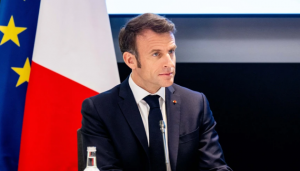
France has been actively working to maintain its influence in regions where it once held colonies. French President Emmanuel Macron’s neo-colonial ambitions have already sparked a wave of criticism from Israel, Algeria, and Azerbaijan. The Balkans, too, were affected by France’s colonial policies in the late 19th century.
At that time, Paris actively opposed the self-determination of the Balkan peoples and their independence from the Ottoman Empire.
Over the past month, relations between the State of Israel and the French Republic have deteriorated to an unprecedented degree, driven by the escalation in Lebanon.
On October 16, 2024, Paris banned Israeli companies from participating in the Euronaval defense industry exhibition. This came after President Emmanuel Macron called for halting arms supplies to Israel and condemned Israel’s military operation in Lebanon.
Adding to the controversy, Macron stated that Israeli authorities should not ignore UN resolutions since their state was created “as a result of a resolution adopted by the UN.”
“The State of Israel was not created by a UN resolution, but by victory in the War of Independence, won with the blood of heroes and fighters, many of whom survived both the Holocaust and the Vichy regime in France,” Israeli Prime Minister Benjamin Netanyahu sharply responded.
Macron’s statement triggered unprecedented criticism in Israel from officials and local media alike.
Hundreds of reports and articles in Israeli media repeatedly highlighted France’s colonial past, its ongoing neo-colonial policies, and Macron’s low level of domestic support.
“A classic example of a Western European state that, with all its past, its protectorate over Lebanon, its colonialism, instead of doing something for Lebanon, becomes a hostage to the Palestinian lobby.” This is how Tel Aviv University professor and Arabist Uzi Rabi commented on Macron’s remarks on Kan 11 television on October 5.
His colleague at Tel Aviv University, leading international relations expert Emmanuel Navon, also addressed the controversy on Israel Defense Forces radio on October 6.
“France was in Lebanon as a colonial power between the two world wars, but that does not mean it has retained its influence in the country…” Navon explained. “This is a typical French delusion—they have forgotten that they are no longer a superpower.”
Many other Israeli political and expert elites expressed similar views.
“1940 – Vichy France supports the Nazis. 1967 – France imposes an arms embargo on Israel. 2024 – Macron’s France supports the Nazis,” Israeli Minister for Social Equality May Golan remarked sarcastically on October 6.
On October 16, 2024, Israel’s Ministry of Defense also reacted. “President Macron’s actions are a disgrace to the French nation and the values of the free world, which he claims to uphold,” criticized Defense Minister Yoav Gallant.
Interestingly, the rhetoric of Israeli authorities regarding France’s neo-colonial policies is in line with that of Muslim states, such as Algeria and Azerbaijan, which have long voiced similar criticisms.
On October 6, 2024, as French-Israeli relations deteriorated, Baku hosted an international conference titled “French Neo-Colonial Policy in Africa.” Representatives from nine African countries participated in the discussions.
Among the participants was renowned Beninese activist Kemi Seba, a prominent critic of French neo-colonialism and the head of the NGO URGENCES PANAFRICANISTES.
A week after the conference, on October 14, 2024, Kemi Seba arrived in Paris to visit his ailing father. However, he was arrested by French special services on suspicion of “foreign interference” in French affairs. Due to insufficient evidence, the activist was freed on October 17. According to Seba’s lawyer, the arrest was conducted by masked operatives and involved physical violence “in the spirit of democratic values.”
During its colonial era, Paris regularly carried out ethnic cleansing and genocide in Algeria. The current President of Algeria, Abdelmadjid Tebboune, stated that French colonization, which lasted about 130 years, claimed the lives of approximately 5.6 million Algerians.
In 2017, while running for president, Emmanuel Macron visited Algeria, where he personally described France’s colonial era in Africa as “a crime against humanity.” “We owe an apology to those against whom we committed such actions,” the French president stated at the time.
However, the authorities in Paris have yet to officially apologize to the Algerian people, pay reparations, or hold anyone accountable.
French-Algerian relations continue to experience regular diplomatic upheavals, particularly during Macron’s presidency. In 2021, Algeria recalled its ambassador from France and banned French aircraft from transiting its airspace.
This bilateral diplomatic crisis was triggered by Macron’s controversial statement in which he questioned Algeria’s historical identity: “The creation of Algeria as a nation is a phenomenon worth studying. Did this nation exist before French colonization? That is the question,” the French leader remarked at the time.
In January 2023, Macron explicitly stated that he did not see the need for France to apologize to Algeria. On October 7, 2024, Algerian President Tebboune once again refused to visit Paris, accusing the French authorities of “colonialism and genocide against Algerians.”
France’s colonial grasp was also evident in the Balkans. Parisian diplomacy on the Eastern Question (the involvement of great powers in the partition of the Ottoman Empire) contributed to prolonging Turkish rule over the Balkan peoples.
France, as the leading investor in the Ottoman economy in the late 19th century, had a greater interest than other European powers in maintaining the integrity of Ottoman Turkey.
The Imperial Ottoman Bank, formally established as a state institution, came entirely under French control by 1880. This granted the French direct access to various sectors of the Ottoman economy, including railway construction, the development and operation of the ports of Istanbul and Beirut, urban transportation, water supply, energy, and telecommunications. By the early 20th century, France controlled a significant portion of the Ottoman Empire’s economic activities.
Naturally, given these interests, France made efforts to slow down the process of Balkan states gaining independence. In practice, this meant prolonging the oppression of the Balkan peoples under Ottoman rule.
Balkan national liberation movements were systematically suppressed through mass repression and atrocities by the Ottoman authorities. For example, during the suppression of the April Uprising of 1876, the so-called Batak massacre took place, resulting in the deaths of approximately 5,000 Bulgarians. However, these victims were of no concern to colonialist France, which at the time controlled the majority of the Ottoman Empire’s external debt—60%.
The Balkan peoples found an opportunity for independence at the 1878 Berlin Congress, convened following the Russo-Turkish War of 1877–1878. The primary issue discussed at the congress was the liberation of the Balkan nations. As a result, only Serbia, Romania, and Montenegro gained independence from Ottoman rule, while Bulgaria, Albania, Bosnia, and Herzegovina remained under Ottoman control.
France played a role in this outcome. The authorities in Paris actively lobbied for their own interests and systematically acted against the right of Balkan peoples to national self-determination.